Showing posts with label gardens. Show all posts

Wednesday, December 21, 2016

Calm Down this Holiday Season with Chamomile

Guest blog entry by Dr. Irwin Richman

What can be more calming than a nice cup of chamomile tea?  The apple-scented tea is made from two different chamomiles:  either German chamomile (Matricaria chamomilla), or Roman or garden chamomile (Chamaemelum nobile).

Chamomile is easy to grow from seed and it reseeds itself.  Roman, or garden, chamomile often naturalizes in lawns, especially in England as, along with English daisies (Bellis), it can survive close trimming.

They have attractive daisy flowers, hence their membership in the Asteraceae family of ray flowers, along with sunflowers and Black-eyed Susans.  Both of these tea making plants are close relatives of the unlovely plant with a beautiful family name, "Ambrosia." Ambrosia psilostachya is a rag weed scourge of hay fever sufferers.  If you have hay fever, chamomile tea might give you a kick you're not seeking.

In the middle ages, a popular garden feature was a turf seat, and earthen sculpture covered in grass which was close cropped.  As a variant, these turf seats could be covered in herbs which could be closely cropped and chamomile was favored because it emits a nice aroma when sat upon.  Another favored herb for this purpose was creeping thyme (Thymus serpyllum).  While few, if any turf seats were built in America, more are known to have survived, but creeping thyme is still used in old PA German cemeteries where it is planted atop graves so that visitors will have fragrant visits.

Another chamomile is dyer's chamomile (Anthemis tinctoria), a widely naturalized perennial herb with hairy, divided leaves and yellow flowers that is Eurasian in origin.  Not medicinal, like German & Roman chamomile, it was used, as the name suggests, as a yellow to orange dyestuff.  Some folks grow it in their gardens for its blossom.  I remember it as a boy growing in the cow pastures during my Catskill Mountain childhood.

All of this & more are in the new book currently being written by Irwin Richman & Michael Emery, Of Ray Flowers & Roses, due in 2019. You can also read about chamomile and other heirlooms in the book, Heritage Gardens, Heirloom Seeds, also written by Richman & Emery.

Thursday, July 7, 2016

Exploring a Hidden Horticultural Treasure


Blog Entry by Shayla Carey

Tucked away in the far corner of the site is a true Landis Valley treasure:  the Brick Garden.  Mainly tended by Heirloom Seed Project volunteer Mickey Blefko, it contains vegetables and herbs in well-weeded raised beds and is surrounded on three sides by flowers.

Despite temperatures close to 90 in the sun, Mickey eagerly gives me a tour on this early July morning, taking me through the paths among the raised beds. “Some of these are here for seed and some are just here for demonstration,” she says.  She points to a row of beets situated half-way into the garden.  “We have 'Deacon Dan' beet seeds for sale, but they are too big for this garden, so we grow other demonstration varieties that we can harvest and eat ourselves.”  The volunteers are careful not to let them go to seed and they are grown in areas remote enough not to adulterate the heirloom population.

'Munchen Bier' radish seed pods
We walk past kale and Swiss chard that were thinned by other volunteers earlier in the day.  She points rows of peppers of various stages of ripeness.  “The Seed Project saves the seed.  But, the great thing about it is that we can keep the fruit after the seeds come out.” I look at her and the same twinkle is in her eyes as is in mine:  we can just taste the stuffed peppers that can be made later in the season.  The same rule goes for tomatoes and Mickey eats them stuffed, too.

The garden is in a constant state of change, as some plants die back and others start again.  A few, such as ‘Munchen Bier’ Radish and ‘Green Star’ bean, are precious and are babied.  The radishes weren’t sold for years and the remaining seed was a few years old, so Mickey was tasked with planting them here and refreshing the genetic supply.  They came back like gangbusters and are now laden with seed pods full of seed.  If nothing kills them before the seed is fully ripe, it will be a true success story.

Beets in the front and 'Green Star' beans climbing poles.
'Amish Paste' tomatoes behind the beans and 'Beste Von Alum'
bush beans to the left.
The beans have a similar story, though they are still in the flowering stage.  ‘Green Star’ is a pole bean that was not for sale for years due to low population and, this year, Mickey was given 20 of the 30 or so seeds left to plant.  “I didn’t know what to expect, so I planted five of them in each corner,” she says as she points to the pole structure that supports healthy plants.  “Wouldn’t you know?  All five in each corner came up!  I had to thin them.”

Most of the plants here do well, though she has had some misfortunes.  Demonstration potatoes that occupied a far corner didn’t germinate, critters got to her peas, and she had to re-plant lavender and rosemary, as even hilling them with straw didn’t ensure their survival through the winter.  But for all of that, the garden is brimming with beautiful bounty.  Mickey encourages visitors to stop by and view the garden from a designated spot along the fence between flower plantings.  “Come back later on and see what’s growing,” Mickey says cheerily as we leave the garden to bask in the July sun.

Friday, April 8, 2016

Baby Bees & Trees

Blog entry by Shayla Carey
Don with rootstocks awaiting grafting
Last week, with the help of Don Zeigler, co-founder of the Backyard Fruit Growers, Landis Valley welcomed 150 baby bees and 20 new baby trees to its horticultural family.

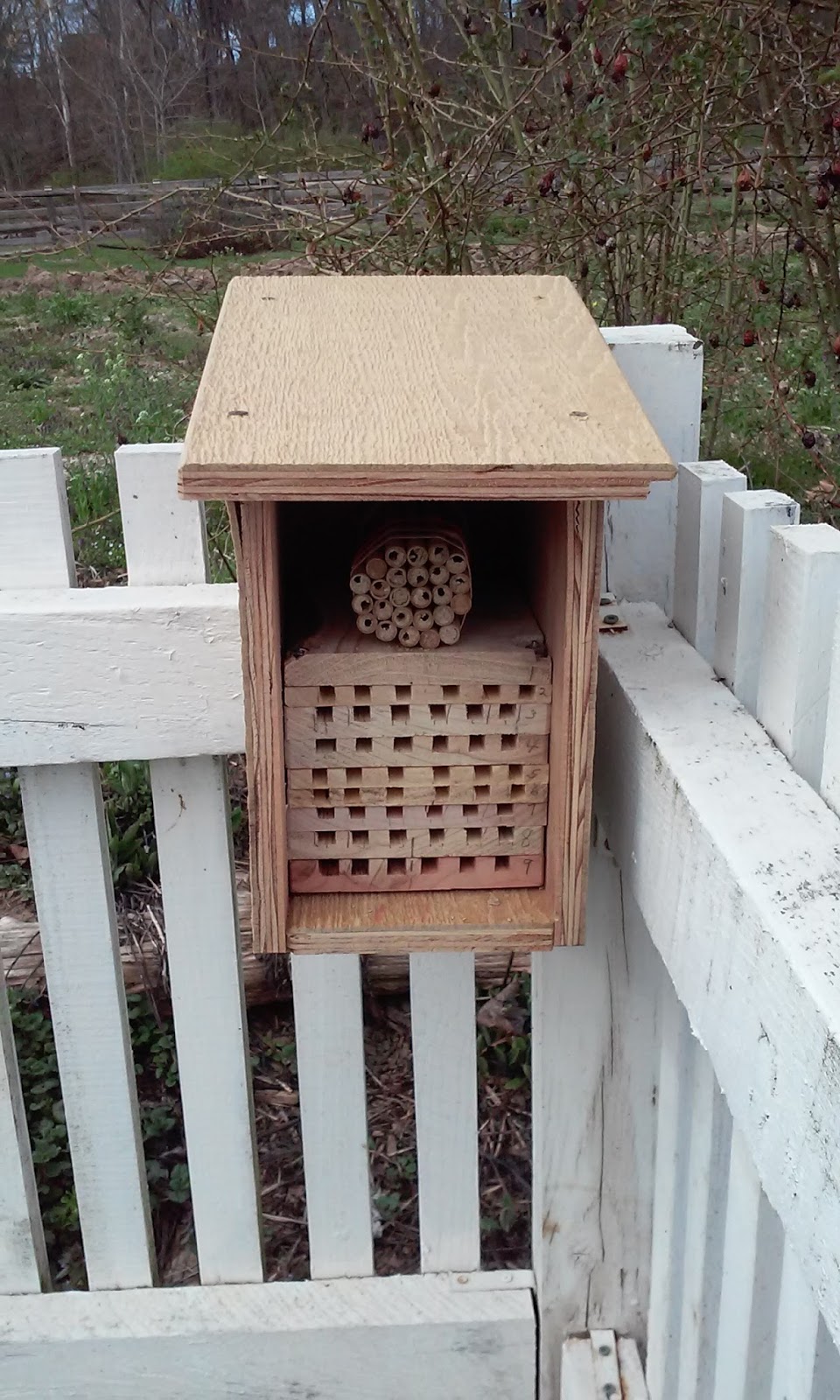
It was an easy delivery:  Don grafted 20 scion wood to rootstock and farm manager Joe Schott attached two new bee boxes to fence posts in the herb garden and behind the Heirloom Seed House.  Don and Joe then inserted tubes filled with mason bee eggs into the boxes.  After that, the waiting began...

What will be exciting is watching the new additions grow.

The moment of truth:
when scion meets rootstock
While we do not grow the apples to sell, we do grow them to keep the genetics going, which is a core mission of the Heirloom Seed Project.  Some of the apple scions (living twigs from mature trees) are from existing trees on Landis Valley property, which are getting rather old and will need to be removed within a few years.  15 others are heritage varieties from the Backyard Fruit Growers’ woodbank, a collection of fruit trees grown by BYFG members that are shared among them.  Our new orchard is currently residing in buckets outside of the greenhouses, but will be permanently located towards the rear of the site and, once they are planted, visitors who wander to the Collections Gallery or to the Maple Grove Schoolhouse can hike a little further up the old Kissel Hill Road and see them.  Honeybees, which are in danger of decline due to CCD, will join the site in April and will eventually assist the mason bees in pollinating the new orchard.  The apples will be used for demonstration purposes.

In a few weeks, the mason bees will emerge from the holes in the boxes (pictured at right), pollinating various plants around the site.  They hatch about 3-4 weeks before honeybees do and they will die at the end of the year after laying more eggs in the boxes in August.  Because of their short lifespan, they do not produce honey, but they are prolific pollinators.  They do not form colonies, so are not subject to colony collapse disorder (CCD).  They are smaller than honeybees, are native to North America, and do not have a stinger, either, which makes this writer like them a lot.


The bees are part of a working relationship that Landis Valley is developing with insects to help bring up productivity of plants around the site.  Because we need all of the seeds we can get from every plant we grow, pollination is hugely important.  Ladybugs, parasitic wasps, and mites also assist plant production in our greenhouses, keeping pests at bay without the need for chemical insecticides.

Apple trees and mason bees – here’s to the beginning of a beautiful friendship.


Tuesday, April 13, 2010

Springtime at Landis Valley


The warmer weather is working wonders around our site! Beautiful clusters of blossoms in shades of pink, white and purple are making their appearance on the trees.


Poke your head in the hoophouse where our seed house volunteers are busy preparing for the Herb Faire and the wonderful smell of basil and other herbs will greet you.


If you visit on a Thursday and walk down to the Log Farm, you might get to watch volunteers, Floyd and John, bundling rye straw and attaching it to the lowered roof of the hay barrack. Thatching is no easy job!