Showing posts with label historic. Show all posts

Friday, September 9, 2016

#AskACurator Day and Other Announcements

Just a short post today with a couple of announcements:

#AskACurator Day

Landis Valley curator Bruce Bomberger will be on-hand from 1:30 to 2:15 p.m. on September 14 to answer your questions about the collection, curating, agricultural technology, and the Landis Brothers, founders of Landis Valley Village & Farm Museum.  Send us your questions and we'll post them on Twitter and Facebook.  No personal questions, please, and no requests for appraisals.


To see our Twitter feed, you can either follow us on Twitter or you can visit our Media page, where we have a Twitter feed embeded.

In other news...

Wool Frolic

On September 17, Landis Valley will host the Wool Frolic & Yarn Sale event.  In this celebration of the fiber arts, you'll get to pet live animals, see a sheep being shorn, and then get to watch wool get spun, woven and needle-felted.  Staff and volunteers will there to teach you the basics of crochet and knitting, or you can stroll around and purchase fiber arts products from one of our vendors. If you're inspired, visit the yarn sale, where we have sorted yarns of all kinds and pattern books for that next project.  It's a great day of fuzzy fun for the family!

Harvest Days

It's an event about Pennsylvania German harvest traditions, but, after 56 years of existence, it's become a tradition itself.  Families come from all over to taste heritage varieties of apples and see them turned into pies, cider, apple butter, and even molasses.  There's wagon rides, too, as well as a pumpkin patch, food vendors, interactive exhibits, a children's discovery tent, and demonstrations of crafts, trades, and machinery.  We also will welcome the Horseless Carriage Club of America when they bring roughly 30 turn-of-the-century vehicles to the Millstone Grove from 11 a.m. to 1 p.m.

Regular admission rates apply to both of these events and, as always, Landis Valley Associates members are free.

Thursday, July 7, 2016

Exploring a Hidden Horticultural Treasure


Blog Entry by Shayla Carey

Tucked away in the far corner of the site is a true Landis Valley treasure:  the Brick Garden.  Mainly tended by Heirloom Seed Project volunteer Mickey Blefko, it contains vegetables and herbs in well-weeded raised beds and is surrounded on three sides by flowers.

Despite temperatures close to 90 in the sun, Mickey eagerly gives me a tour on this early July morning, taking me through the paths among the raised beds. “Some of these are here for seed and some are just here for demonstration,” she says.  She points to a row of beets situated half-way into the garden.  “We have 'Deacon Dan' beet seeds for sale, but they are too big for this garden, so we grow other demonstration varieties that we can harvest and eat ourselves.”  The volunteers are careful not to let them go to seed and they are grown in areas remote enough not to adulterate the heirloom population.

'Munchen Bier' radish seed pods
We walk past kale and Swiss chard that were thinned by other volunteers earlier in the day.  She points rows of peppers of various stages of ripeness.  “The Seed Project saves the seed.  But, the great thing about it is that we can keep the fruit after the seeds come out.” I look at her and the same twinkle is in her eyes as is in mine:  we can just taste the stuffed peppers that can be made later in the season.  The same rule goes for tomatoes and Mickey eats them stuffed, too.

The garden is in a constant state of change, as some plants die back and others start again.  A few, such as ‘Munchen Bier’ Radish and ‘Green Star’ bean, are precious and are babied.  The radishes weren’t sold for years and the remaining seed was a few years old, so Mickey was tasked with planting them here and refreshing the genetic supply.  They came back like gangbusters and are now laden with seed pods full of seed.  If nothing kills them before the seed is fully ripe, it will be a true success story.

Beets in the front and 'Green Star' beans climbing poles.
'Amish Paste' tomatoes behind the beans and 'Beste Von Alum'
bush beans to the left.
The beans have a similar story, though they are still in the flowering stage.  ‘Green Star’ is a pole bean that was not for sale for years due to low population and, this year, Mickey was given 20 of the 30 or so seeds left to plant.  “I didn’t know what to expect, so I planted five of them in each corner,” she says as she points to the pole structure that supports healthy plants.  “Wouldn’t you know?  All five in each corner came up!  I had to thin them.”

Most of the plants here do well, though she has had some misfortunes.  Demonstration potatoes that occupied a far corner didn’t germinate, critters got to her peas, and she had to re-plant lavender and rosemary, as even hilling them with straw didn’t ensure their survival through the winter.  But for all of that, the garden is brimming with beautiful bounty.  Mickey encourages visitors to stop by and view the garden from a designated spot along the fence between flower plantings.  “Come back later on and see what’s growing,” Mickey says cheerily as we leave the garden to bask in the July sun.

Friday, April 8, 2016

Baby Bees & Trees

Blog entry by Shayla Carey
Don with rootstocks awaiting grafting
Last week, with the help of Don Zeigler, co-founder of the Backyard Fruit Growers, Landis Valley welcomed 150 baby bees and 20 new baby trees to its horticultural family.

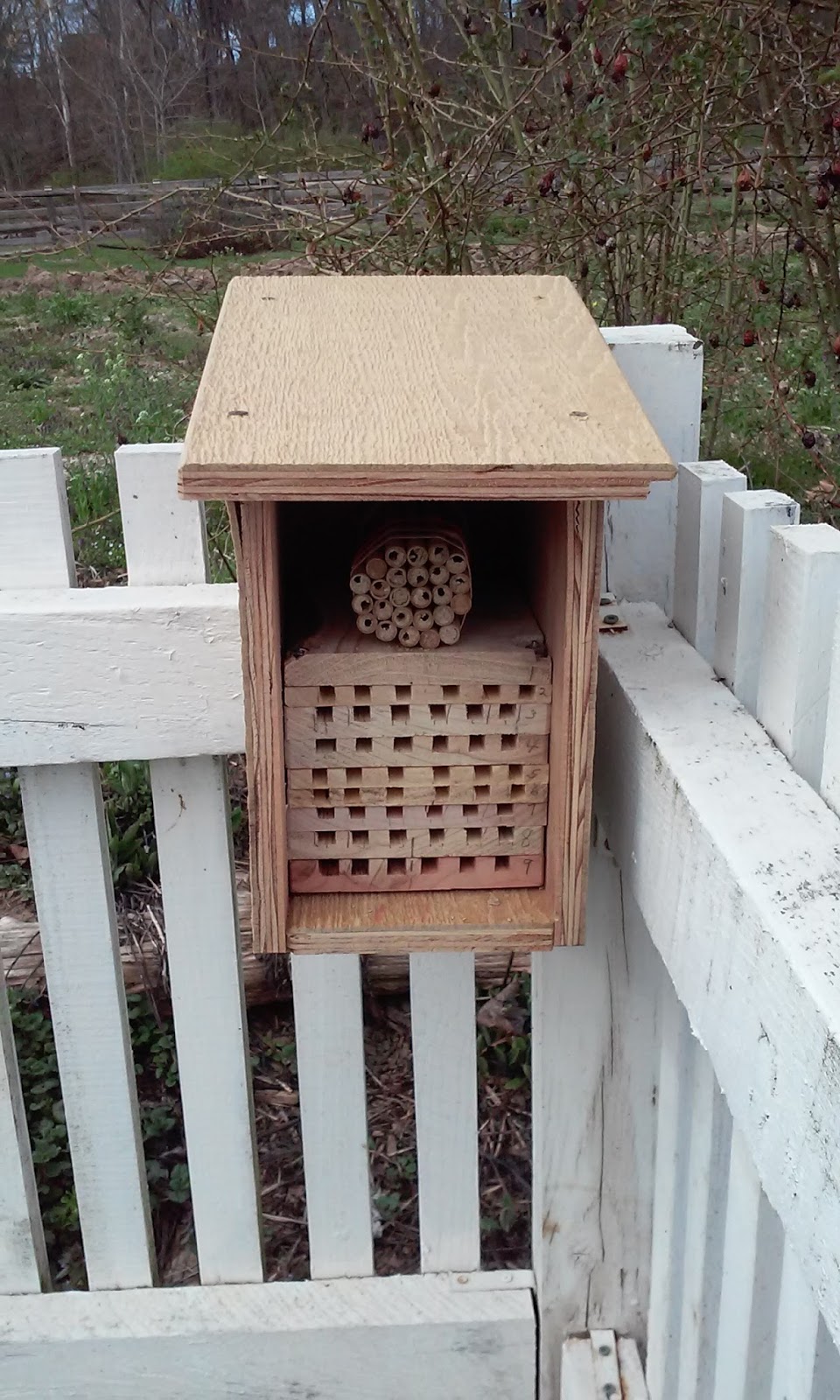
It was an easy delivery:  Don grafted 20 scion wood to rootstock and farm manager Joe Schott attached two new bee boxes to fence posts in the herb garden and behind the Heirloom Seed House.  Don and Joe then inserted tubes filled with mason bee eggs into the boxes.  After that, the waiting began...

What will be exciting is watching the new additions grow.

The moment of truth:
when scion meets rootstock
While we do not grow the apples to sell, we do grow them to keep the genetics going, which is a core mission of the Heirloom Seed Project.  Some of the apple scions (living twigs from mature trees) are from existing trees on Landis Valley property, which are getting rather old and will need to be removed within a few years.  15 others are heritage varieties from the Backyard Fruit Growers’ woodbank, a collection of fruit trees grown by BYFG members that are shared among them.  Our new orchard is currently residing in buckets outside of the greenhouses, but will be permanently located towards the rear of the site and, once they are planted, visitors who wander to the Collections Gallery or to the Maple Grove Schoolhouse can hike a little further up the old Kissel Hill Road and see them.  Honeybees, which are in danger of decline due to CCD, will join the site in April and will eventually assist the mason bees in pollinating the new orchard.  The apples will be used for demonstration purposes.

In a few weeks, the mason bees will emerge from the holes in the boxes (pictured at right), pollinating various plants around the site.  They hatch about 3-4 weeks before honeybees do and they will die at the end of the year after laying more eggs in the boxes in August.  Because of their short lifespan, they do not produce honey, but they are prolific pollinators.  They do not form colonies, so are not subject to colony collapse disorder (CCD).  They are smaller than honeybees, are native to North America, and do not have a stinger, either, which makes this writer like them a lot.


The bees are part of a working relationship that Landis Valley is developing with insects to help bring up productivity of plants around the site.  Because we need all of the seeds we can get from every plant we grow, pollination is hugely important.  Ladybugs, parasitic wasps, and mites also assist plant production in our greenhouses, keeping pests at bay without the need for chemical insecticides.

Apple trees and mason bees – here’s to the beginning of a beautiful friendship.


Tuesday, November 24, 2015

Preserving the Fortna Family’s Pumpkin Pie

Blog entry by Joanne Ranck-Dirks
A pair of Fortna White pumpkins
The Heirloom Seed Project is committed to seed preservation.  One piece of the program that brings us joy is sharing these garden heirlooms with others and also knowing that sometimes we’re saving more than seeds!

Last April, a seed order arrived for just one packet of seeds – the Fortna White Pumpkin.  The shipping charge was higher than the price of that one packet of seeds so I pondered how I could increase the value of those seeds to the customer so that she wouldn’t mind paying more in postage that she did for the seeds!  Perhaps sharing the history of the pumpkin could add some value.

Every seed donated to the Heirloom Seed Project is documented in an old card file.  I went digging into the file to learn more of the history of the Fortna While Pumpkin.  It had been donated 25 years ago in 1990 and had been grown by the Fortna families in Franklin and Adams Counties.  It is an unusual white, pear-shaped pumpkin and creamy yellow on the inside.  To my amazement, I saw that it had been donated by the same person who was now ordering the seed!

I sent Sue a quick email and said, “This is your family’s pumpkin!”  She replied, “I am not the farmer my dad was, by any means!!”  I did grow one pumpkin last year and didn’t let the seeds dry as long as I should have, and the seeds molded.”

“So I am extremely grateful that you do the hard work of keeping these heritage seeds alive – if you hadn’t had the seed, it would surely have died out with my generation. (Not to mention that all the extended family would have been so disappointed to not have a Fortna Pumpkin Pie at Thanksgiving – we all still think it’s the best for pies!)”


Happy Thanksgiving to the Fortna Family.  We hope you enjoy your pie!